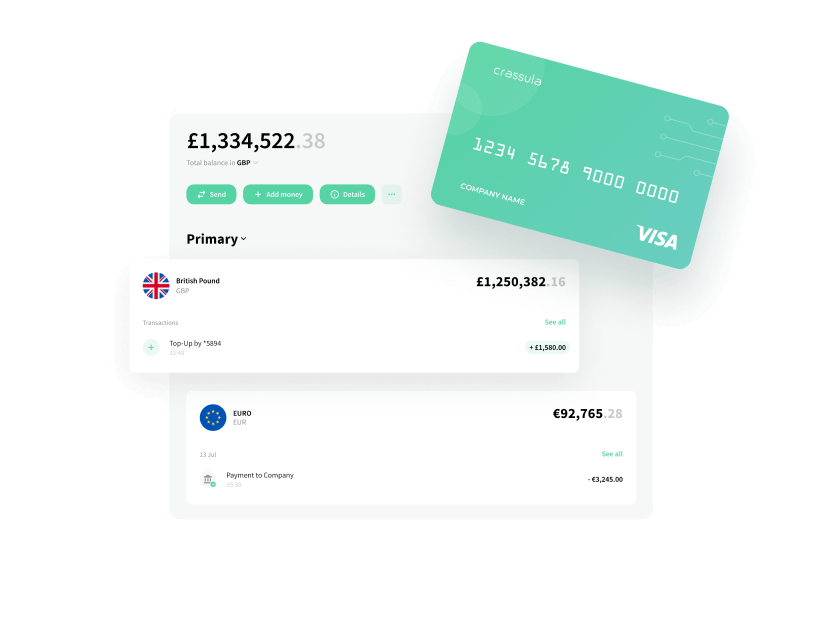

Consumer Banking Software in 2026: Features, Architecture and Vendors
A 2026 guide to consumer and retail banking software: what it is, must-have features, architecture patterns, buy vs build vs white-label, digital experience expectations, and how Crassula fits.
What is consumer banking software?
Consumer banking software is the technology stack that powers the products most people use every day: current accounts, savings accounts, debit and credit cards, personal loans, mortgages, and mobile banking apps. It differs from corporate or private banking software in one important way - volume. A retail banking platform must serve millions of customers simultaneously, keep every transaction consistent, and still deliver a response in under a second.
In 2026 the term covers two distinct layers. The first is the core ledger - the software that holds account balances, books debits and credits, applies interest, and manages product parameters. The second is the engagement layer - mobile apps, web portals, customer service tools, and the integrations that tie everything to payment rails, card networks, and third-party services. Competitive advantage has shifted decisively toward the engagement layer, but it rests entirely on the quality of the ledger underneath.
Retail-scale ledger
Handles millions of accounts and hundreds of millions of transactions per year. Every debit, credit, and balance query must be accurate and near-instant.
Digital engagement layer
Mobile apps, web banking, customer dashboards. This is where users experience the product and where brand differentiation lives.
Integration backbone
APIs connecting to card networks, payment rails (SEPA, Faster Payments, SWIFT), KYC providers, credit bureaus, and open banking aggregators.
Who uses it? Traditional retail banks, challenger banks, neobanks, credit unions, and any fintech that wants to offer banking products to end consumers. The software category spans global giants like Temenos Transact down to white-label SaaS platforms like Crassula that let a new entrant go live in weeks.
Let's discuss your project and see how we can launch your digital banking product together
Request demoMust-have features for retail banking software
A retail banking platform in 2026 must do more than open accounts and move money. Customer expectations - shaped by the best consumer apps in any category, not just fintech - set a high bar. Below are the functional modules that every serious platform covers.
| Module | What it must do in 2026 |
|---|---|
| Account management | Real-time balance, transaction history, multi-currency, virtual sub-accounts, joint accounts, automated interest calculation |
| Cards | Debit and credit card issuance, virtual cards, spend controls, instant freeze/unfreeze, Apple Pay and Google Pay tokenisation |
| Payments | Domestic and international transfers, SEPA Credit Transfer and Instant, Faster Payments, SWIFT, bill payments, scheduled and recurring transfers |
| Digital onboarding | eKYC (document scan, liveness check, identity verification), account opening in minutes, PEP/sanctions screening |
| Mobile banking app | iOS and Android, biometric authentication, push notifications, in-app customer support (chat/bot), spending analytics |
| Lending | Personal loans and overdrafts, automated credit scoring, loan origination workflow, repayment scheduling |
| Customer data and CRM | 360-degree customer view, behavioural data, segmentation, personalised product offers |
| Compliance and reporting | AML/transaction monitoring, regulatory reporting (FINREP, local prudential), audit trail, data residency controls |
Three features that separate good platforms from average ones deserve extra attention. First, workflow automation: loan origination, KYC re-verification, and transaction settlement should run without manual handoffs. Second, ISO 20022 readiness: the new messaging standard is now mandatory across SEPA, Faster Payments, and SWIFT. Third, open banking APIs: PSD2 compliance is a legal floor in the EU, not a stretch goal, and the best platforms treat open banking as a growth channel rather than a compliance cost.
Architecture overview
Modern consumer banking software is built in layers. Each layer can be upgraded or replaced independently, which is what separates cloud-native platforms from legacy monoliths where changing one module risks breaking everything else.
Core and data layer
The ledger, product engine, and general ledger. Manages accounts, balances, and postings. Event-driven and immutable - every state change is a new event, not an overwrite. This is the layer that regulators care most about.
Integration and services layer
API gateway, event bus, and connectors to external systems: card processors, payment schemes, KYC vendors, credit bureaus, open banking aggregators. Usually microservices, often event-driven.
Channel and experience layer
Mobile apps (iOS/Android), web banking portal, branch teller tools, and the BFF (Backend for Frontend) APIs that serve them. This layer changes most frequently and should be deployable independently.
Compliance and risk layer
AML engines, fraud detection, transaction monitoring, regulatory reporting pipelines. Increasingly AI-assisted, but must remain explainable to supervisors.
The architectural shift that matters most in 2026 is the move from batch to real-time. Legacy retail banking platforms ran nightly batch jobs to post transactions, calculate interest, and generate statements. Cloud-native platforms process everything in real-time, which means a customer always sees the accurate balance - not last night's balance. That single change eliminates an entire class of customer complaints and fraud scenarios.
For deeper reading on the components, the core banking systems guide covers the ledger in detail, and the banking architecture guide covers the layered model end to end.
Buy vs build vs white-label
This is the most consequential technology decision a retail banking startup or a bank modernising its stack will make. The right answer depends on your timeline, budget, team capacity, and what you actually want to differentiate on.
| Approach | Time to market | Cost | Differentiation | Best for |
|---|---|---|---|---|
| Build from scratch | 3-5 years | Very high ($20M+) | Maximum | Tier-1 banks with large engineering teams |
| License a vendor core | 12-24 months | High ($2M-$10M setup + licences) | Moderate | Mid-size banks replacing legacy systems |
| White-label / SaaS platform | 2-6 months | Low to moderate (SaaS subscription) | UI and product design | Neobanks, fintechs, new market entrants |
The most common mistake is overestimating how much differentiation comes from the ledger. Most retail banks compete on brand, UX, rates, and distribution - not on the internals of how a debit is posted. A white-label platform handles the regulated infrastructure (ledger, payments, cards, KYC pipeline) and frees the team to focus on the things customers actually notice: the app, the product design, the rate, and the service.
There is also a hybrid path: start with a white-label platform, go live, acquire customers, generate revenue, and then selectively build proprietary components where the return justifies the investment. Most successful neobanks followed exactly this path.
UX and digital-experience expectations in 2026
Consumer expectations for banking apps in 2026 are calibrated against the best apps in any category - not against other banking apps. That means instant responses, clear and human language, proactive notifications, and zero unexplained errors. A few specific expectations now feel like table stakes rather than premium features.
Account opening in minutes
Fully digital onboarding with document scanning and liveness verification. Any process that requires a branch visit or paper form loses customers at sign-up. Research from 2025 shows abandonment rates above 60% when onboarding takes more than 10 minutes.
Real-time push notifications
Every card transaction, transfer, and balance change should generate an instant push. Customers who are notified in real time report higher trust and lower fraud claim rates.
Spending analytics
Auto-categorised transactions, monthly summaries, budget tracking. These features drive app engagement and reduce churn - customers who use analytics features are significantly more likely to recommend the bank.
In-app support
Chat-first support with AI-assisted triage and human escalation. Phone-only support is not viable at consumer scale. The software platform must provide the tools for fast, context-aware support without switching channels.
Personalisation is the next frontier. AI-driven consumer banking platforms now use transaction data to surface relevant offers - a savings product when income increases, a short-term loan when spending spikes before salary date - without feeling intrusive. The platforms that get the personalisation engine right will outperform those that deliver only generic product catalogues.
Where Crassula fits
Crassula is a white-label consumer banking platform built for companies that want to launch a retail banking product without building the regulated infrastructure from scratch. The platform provides the complete stack: core ledger, multi-currency accounts, card issuing, domestic and international payment rails, digital onboarding with KYC, and branded mobile and web apps.
Fast launch
Go from decision to live product in 2 to 6 months. The regulatory and technical groundwork is already built - the team focuses on brand, UX, and customer acquisition.
Complete stack
Accounts, cards, payments, KYC, compliance tools, and customer-facing apps in one platform. No need to integrate five separate vendors on day one.
Grows with you
Add products, markets, and currencies without replacing the platform. API-first architecture means proprietary features can be built on top as the business scales.
Crassula suits three types of clients: fintechs and startup banks launching their first consumer product, established businesses (e-commerce, telecoms, employer benefit platforms) adding financial services to their offering, and regional banks looking to modernise their digital channel without a full core replacement. In each case the goal is the same - reach market with a high-quality product faster than a build-from-scratch approach would allow.
FAQ
Consumer banking software is the technology platform that powers retail banking products for individual customers: current and savings accounts, debit and credit cards, personal loans, and mobile and web banking apps. It includes both the core ledger - which keeps accurate balances and books every transaction - and the engagement layer that customers interact with directly. In 2026, leading platforms are cloud-native, API-first, and real-time, replacing the batch-processing monoliths that defined the previous generation of retail banking systems.
The essentials in 2026 are: real-time account management with multi-currency support, card issuance (physical and virtual) with instant controls, domestic and international payment rails (SEPA, Faster Payments, SWIFT), digital onboarding with eKYC (document scan and liveness check), a branded mobile app for iOS and Android with biometrics and push notifications, lending and overdraft functionality, a CRM with 360-degree customer view, and AML/compliance tooling including transaction monitoring and regulatory reporting. ISO 20022 readiness and open banking API support are now baseline requirements in most regulated markets.
Consumer (retail) banking software is designed for high volumes of individual customers with relatively standardised products - current accounts, cards, small loans. The emphasis is on self-service, mobile-first UX, automation, and scale. Private banking software serves high-net-worth individuals and adds portfolio management, multi-asset custody, structured products, and relationship management tools. Corporate banking software handles business accounts, trade finance, cash management, treasury, and complex credit facilities. The architectures overlap at the core ledger level, but the product set and UX requirements diverge significantly above that layer. See the private banking software guide for the HNW comparison.
For most new entrants and mid-market operators, buying or licensing a white-label platform is the right answer. Building a compliant retail banking platform from scratch takes 3-5 years and costs upwards of $20 million before the first customer is onboarded. A white-label or SaaS platform compresses that to 2-6 months at a fraction of the cost, and the majority of the differentiation customers care about - UX, product design, rate, brand - can still be customised on top of the platform. Building from scratch makes sense only for tier-1 banks with engineering organisations large enough to maintain the result. A common middle path is to launch on a platform, generate revenue, and then selectively build proprietary components where the competitive return justifies the investment.
Crassula provides a white-label consumer banking platform covering the full product stack: core ledger, multi-currency accounts, debit and credit card issuing, payment rails (SEPA, SWIFT, local schemes), digital onboarding with integrated KYC, AML compliance tools, and branded mobile and web banking apps. Clients configure their own product suite, branding, and pricing on top of the platform. A typical launch takes 2-6 months from contract to live. Crassula supports both new banking licence holders and EMI/PI-licensed fintechs that want to offer consumer banking products without building regulated infrastructure themselves.