
The Money Transfer Industry in 2026: Models, Players and How to Launch
A 2026 overview of the global money transfer and remittance industry: market size, business models, payment rails (SWIFT, SEPA, ACH, mobile money), licensing categories (PI, MSB, MTL), key players and how white-label platforms let new operators launch without building from scratch.
The global remittance industry: size and significance
The money transfer industry moves value across borders for individuals, families and businesses. In 2022, formally recorded remittances to low and middle-income countries reached $647 billion, while total global flows (World Bank) topped $831 billion. Those figures exceed official development aid by more than three times and rival foreign direct investment in many receiving economies.
In countries such as Tonga, Lebanon, Samoa and Tajikistan, remittances represent 30% or more of GDP. The top receiving nations by volume are India, Mexico, China, the Philippines and Egypt. The largest sender countries are the United States, Saudi Arabia, the UAE, Switzerland, Germany and China.
The cost of sending money remains a persistent problem. The global average of 6.18% for a $200 transfer is double the UN Sustainable Development Goal target of 3% by 2030. Sub-Saharan Africa corridors often cost 8 to 10% or more. Reducing that cost gap is both a regulatory priority and a commercial opportunity for new entrants.
Top corridors by volume include USA to Mexico, USA to China, USA to India, Saudi Arabia to India, UAE to India and Germany to Turkey. These six corridors alone account for a significant share of global formal flows, which is why they attract the most competitive pricing and the most regulatory scrutiny.
Let's discuss your project and see how we can launch your digital banking product together
Request demoBusiness models: P2P, B2B, remittance corridors and FX margin
The money transfer ecosystem contains several distinct business models. Understanding which one you are operating shapes the licence you need, the infrastructure you build and the margins you can expect.
| Model | Who sends | Typical ticket | Revenue source | Examples |
|---|---|---|---|---|
| P2P consumer remittance | Migrant workers sending to family | $100 to $500 | Flat fee + FX spread (1.5% to 5% total) | Wise, Remitly, WorldRemit, Ria |
| B2B cross-border | SMEs, platforms, marketplaces | $5k to $500k | FX spread (20 to 80 bps) | Airwallex, Nium, Currencycloud |
| Bulk payroll / disbursement | Employers paying overseas workers | Batch of thousands | Per-payment fee + FX | Papaya Global, Deel, Remote |
| Agent cash network | Unbanked senders paying in cash | $50 to $1k | Fee + FX (5% to 10%) | Western Union, MoneyGram |
| Hawala / informal | Trust-based diaspora networks | Variable | Small commission | Not commercially regulated |
Money Transfer Operators (MTOs) generate revenue through two main lines. First, a transparent transfer fee shown to the customer at checkout - either a fixed amount, a percentage of the amount sent, or a tiered structure. Second, a hidden FX margin built into the exchange rate quoted to the customer versus the mid-market rate the operator actually pays.
The transfer lifecycle runs in four stages: initiation (customer instruction and payment collection), transmission (routing instructions across the network), payout (beneficiary receives funds in cash, bank credit or mobile wallet) and settlement (correspondent reconciliation between sending and receiving sides). The economics of each stage vary dramatically by corridor and by payout method.
Cash payout
Still dominant in many corridors. Agent networks charge 5 to 8% of the send value as payout cost, which drives overall transaction fees higher.
Bank account credit
Lower cost than cash. Requires the beneficiary to have a bank account. Used in most developed-economy corridors.
Mobile money
M-Pesa, MTN Mobile Money, GCash and similar wallets have extended reach to unbanked populations across Africa and South-East Asia.
Rails and infrastructure: SWIFT, SEPA, local rails and correspondent banking
A money transfer product sits on top of a layered stack of payment infrastructure. Understanding the rails determines what speed, cost and geographic coverage you can offer customers.
| Rail | Geographic scope | Typical speed | Best for |
|---|---|---|---|
| SWIFT (gpi) | Global, 11,000+ institutions | Minutes to 1 day (gpi); up to 3 days (legacy) | High-value B2B transfers, corridors without a better rail |
| SEPA Credit Transfer (SCT) | 36 SEPA countries | Next business day | EUR retail and B2B intra-EU payments |
| SEPA Instant (SCT Inst) | 36 SEPA countries | 10 seconds, 24/7 | Mandatory for EU PSPs from October 2025 |
| ACH (US) | United States | Same day to next day | Low-cost USD collect and payout |
| Faster Payments (UK) | United Kingdom | Seconds | GBP retail collections and payouts |
| UPI (India) | India | Instant | INR payout to Indian beneficiaries |
| Pix (Brazil) | Brazil | Instant, 24/7 | BRL payout to Brazilian beneficiaries |
| Mobile money (M-Pesa etc.) | Africa, South-East Asia | Near-instant | Payout to unbanked and under-banked recipients |
Correspondent banking sits underneath most of these rails. When a small MTO sends money from Germany to the Philippines, it typically holds pre-funded accounts at correspondent banks in both currencies. The German correspondent receives the EUR, the Philippine correspondent releases the PHP. The speed of the payment depends on the relationship between these correspondents and the quality of the instructions sent along the wire.
A significant challenge in the 2020s has been correspondent bank de-risking. Tier-1 banks cut ties with thousands of smaller MTOs and MSBs due to AML compliance costs and sanctions risk. Challenger banks (Banking Circle, LHV, ClearBank in Europe; Cross River and Lead Bank in the US) have stepped into that gap, but at higher per-transaction costs. New operators often find that access to banking is harder to obtain than a licence.
Payout aggregators - Thunes, Mastercard Move, Visa Direct, TerraPay, Onafriq - have changed the economics by front-ending hundreds of local rails behind a single integration. Instead of negotiating bilateral agreements in 50 countries, an MTO signs one aggregator contract and gains access to bank accounts, wallets and cash networks globally.
Licensing to run a money transfer business: PI, MSB and MTL
Money transfer is one of the most regulated activities in financial services. Every significant jurisdiction requires a licence before you can move funds on behalf of third parties. The main licence categories are:
EU - Payment Institution (PI)
Under PSD2 (moving to PSD3/PSR from 2026 to 2027), money remittance is an explicitly regulated service. A remittance-only PI requires minimum initial capital of EUR 20,000. A full PI (covering more payment services) requires EUR 125,000. One EEA PI licence passports across all 27 EU member states plus Norway, Iceland and Liechtenstein. Key regulators: BaFin (Germany), Banco de España, ACPR (France), Central Bank of Ireland, Bank of Lithuania.
UK - FCA Authorised PI
The UK FCA issues Payment Institution authorisation and registration for money remittance. Safeguarding of client funds under the Payment Services Regulations 2017 is strictly enforced. Minimum capital EUR 20,000 to EUR 125,000. The FCA review runs 6 to 12 months. Post-Brexit, UK authorisation no longer passports to the EU.
USA - MSB and state MTLs
FinCEN registration as a Money Services Business (MSB) is federal and relatively quick. However, each state also requires its own Money Transmitter License (MTL). Running in all 50 states takes 18 to 24 months and costs $3M to $7M in bonds, fees and legal. The NMLS Multi-State Licensing Agreement helps, but there is no single federal licence for money transmission.
Other key jurisdictions
Canada: FINTRAC Money Services Business registration (federal) plus provincial registration in Quebec (AMF). Australia: AUSTRAC remittance network registration, relatively fast. Singapore: MAS Major Payment Institution licence. UAE: CBUAE retail payment services licence.
All licensees must comply with FATF Recommendation 14 (special measures for money transfer services) and Recommendation 16 (the travel rule - originator and beneficiary information must accompany each payment). In practice this means a full AML/CFT programme: KYC and CDD at onboarding, ongoing transaction monitoring, sanctions screening, suspicious activity reporting to the local Financial Intelligence Unit, and record-keeping for at least five years.
A common 2026 launch path: obtain an EU remittance-only PI first (lowest capital, fastest timeline), passport across the EEA, add UK FCA and Canada FINTRAC in parallel, then tackle US state MTLs once corridor volumes justify the expense. Operate in unlicensed markets as an agent under an existing licensee's umbrella while your own applications are in progress.
Build vs white-label: how to launch a money transfer product
Once licensing and correspondent banking are in place, a new money transfer operator faces a build-or-buy decision for the product itself. Three paths exist:
| Path | Time to MVP | Upfront cost | Best fit |
|---|---|---|---|
| Build in-house | 12 to 24 months | $2M to $10M plus engineering team | Well-funded operators with unusual product requirements or a proprietary corridor advantage |
| Integrate a payment API stack | 6 to 12 months | $500k to $2M plus ongoing integration cost | Operators with a technical team who want to own the customer experience but outsource rails |
| White-label platform (e.g. Crassula) | 8 to 12 weeks to MVP | Low six figures, SaaS subscription | New PIs, EMIs and MSBs who need a production-grade product quickly without a large engineering investment |
Building from scratch gives maximum control but is rarely justified for the first version. The competitive advantage in money transfer comes from corridor selection, pricing, banking relationships and compliance quality - not from owning custom ledger code. Most operators outside the top tier are better served by a configurable platform they can brand and go live on in weeks.
Key components any money transfer platform must include:
Corridor and FX engine
Per-corridor routing rules, real-time pricing, spread management and auto-hedging.
Multi-currency ledger
Double-entry, real-time, reconciled to the correspondent account at every cut-off.
Compliance layer
KYC, sanctions screening, transaction monitoring, travel-rule messaging, SAR workflow.
Customer apps and back office
Branded web and mobile send flows, admin console for ops and compliance teams.
Challenges that trip up early-stage operators: agent network liquidity (cash payout agents need pre-funded float), FX volatility in exotic corridors, the digital divide among target users who may not have smartphones or bank accounts, and the ongoing cost of AML compliance which typically runs 15 to 25% of operating cost in year one.
Where Crassula fits in the money transfer stack
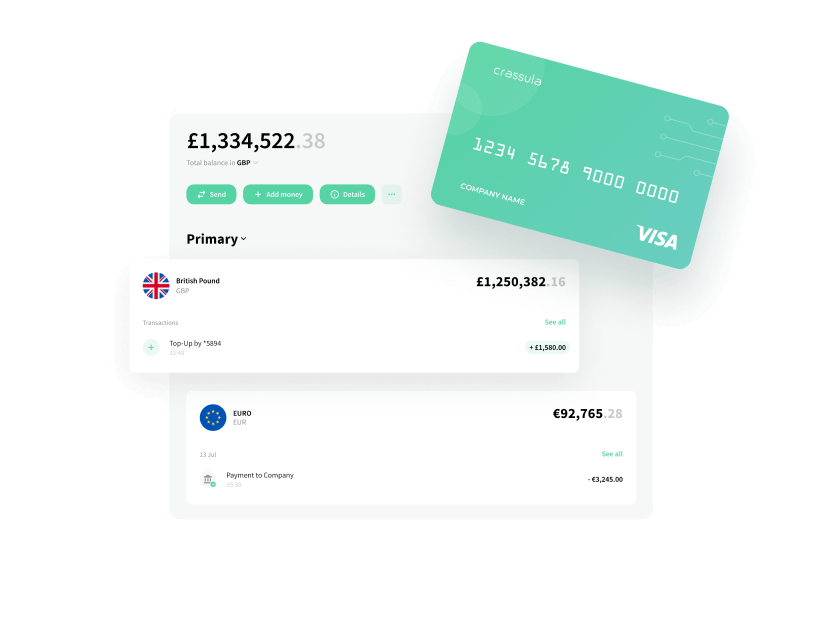
Crassula is a white-label platform designed for licensed payment operators who want to launch a branded money transfer product without spending a year or more building one. The platform covers every layer a new MTO needs:
Remittance core
Corridor routing, FX engine with spread management, quote-and-send flows, multi-currency ledger and settlement reporting.
Compliance built in
KYC and KYB orchestration, sanctions and PEP screening, transaction monitoring, FATF travel-rule messaging and SAR workflow.
Pre-wired rails
SWIFT, SEPA, SEPA Instant, UK Faster Payments, US ACH, card push via Visa Direct and Mastercard Move, mobile money via Thunes and aggregators.
Branded apps
iOS, Android and web send flows in your brand, ready to submit to app stores.
Admin back office
Operations and compliance console, role-based access, full audit trail and regulatory reporting exports.
BaaS partner access
No licence yet? Plug into one of our BaaS partners while your own PI or EMI application is in review.
You bring the licence (PI, EMI, MSB, MTL) or operate under a BaaS partner. Crassula delivers the product layer. Most operators reach a working MVP in 8 to 12 weeks and a production launch within 4 to 6 months.
See the full money transfer solution for the product overview. If you want a step-by-step walkthrough of the licensing, banking access, corridor selection and unit economics involved in launching, see our companion guide: How to Start a Money Transfer Business in 2026. Or book a demo to see the platform in action.
FAQ
The World Bank recorded total global remittance flows of $831 billion in 2022, of which $647 billion went to low and middle-income countries. That makes remittances a larger source of external finance for developing economies than official aid and, in many countries, larger than foreign direct investment. Add B2B cross-border payments and the total addressable volume exceeds $40 trillion per year.
Two revenue lines: a visible transfer fee (fixed, percentage or tiered) charged to the sender, and a hidden FX margin built into the exchange rate shown to the customer versus the mid-market rate the operator actually pays. Consumer operators typically earn 150 to 500 bps gross on the send amount. After paying rail costs, FX hedging, compliance and agent commissions, contribution margin is often 50 to 150 bps. B2B operators run tighter spreads (20 to 80 bps) but with much higher transaction values.
It depends on where you operate. In the EU, a Payment Institution (PI) licence with money remittance permission under PSD2. In the UK, FCA Authorised Payment Institution status. In the US, FinCEN MSB registration plus a Money Transmitter Licence (MTL) in each state of operation - around 49 separate licences for full coverage. In Canada, FINTRAC registration. In Australia, AUSTRAC remittance network registration. Almost every jurisdiction also requires AML/CFT programme compliance with FATF Recommendations 14 and 16.
The main rails are: SWIFT (global interbank messaging, used for most large-value cross-border wires), SEPA Credit Transfer and SEPA Instant (EUR payments across 36 European countries), ACH (US domestic), Faster Payments (UK), UPI (India), Pix (Brazil) and mobile money networks like M-Pesa, MTN and GCash. Correspondent banking underpins all of these - the MTO holds pre-funded accounts at banks in the send and receive countries and routes through them. Payout aggregators such as Thunes and Mastercard Move front-end hundreds of local rails behind a single integration.
The fastest path is a white-label platform rather than a custom build. A platform like Crassula provides the corridor engine, ledger, compliance layer, customer apps and admin back office out of the box. You bring the licence (or operate under a BaaS partner while yours is in review) and connect your correspondent accounts. Most operators reach an MVP in 8 to 12 weeks this way, versus 12 to 24 months for an in-house build. See our step-by-step launch guide for the full roadmap.