
Crypto Banking as a Service in 2026: Architecture, Software and Launch Path
A practical 2026 guide to crypto banking as a service: what it means, what software it takes, how to combine fiat IBANs with crypto wallets in one product, the white-label development path, MiCA/CASP compliance, and how Crassula gets you to market.
What crypto banking as a service means
Crypto Banking as a Service (CBaaS) describes financial infrastructure built specifically for digital asset businesses - and the white-label model that lets fintechs offer that infrastructure to their own customers under their own brand. It sits at the intersection of two previously separate worlds: the regulated banking stack (IBANs, payment rails, AML/KYC, fiat settlement) and the crypto-native stack (wallets, custody, on-chain transactions, staking).
Traditional banking accounts fall short for crypto businesses in concrete ways. A crypto exchange needs real-time fiat conversion and segregated client money accounts. A DeFi protocol needs treasury management for native tokens. A Web3 gaming company runs token economies that conventional payment processors reject outright. A mining operation has capital cycles tied to block rewards and energy contracts that no retail SME banking product was designed to handle.
Regulated fiat rail
Dedicated IBANs, SEPA and SWIFT access, segregated accounts, regulated AML/KYC - the banking layer a crypto business needs to operate legally.
Crypto-native layer
Multi-chain wallets, custody, on-chain and off-chain transfers, staking, and exchange connectivity - the digital asset capability the product needs.
White-label delivery
The combined stack delivered as a branded product - your logo, your UX, your pricing - without building the infrastructure yourself.
CBaaS providers are not necessarily crypto custodians. Many operate as secure intermediaries: they hold the regulated banking relationships and the integration fabric, while specialist custodians (e.g. Fireblocks, Copper, BitGo) hold the keys. The CBaaS provider stitches the two sides together and presents them as a single coherent product.
Let's discuss your project and see how we can launch your digital banking product together
Request demoCrypto bank software components
Crypto bank software is an integrated platform that enables a financial institution or fintech to hold, exchange, and manage digital assets alongside fiat. The component list is longer than a standard banking stack because it has to cover both sides of the fiat-crypto boundary.
| Component | What it does | Key requirements |
|---|---|---|
| Multi-currency wallets | Holds BTC, ETH, stablecoins (USDC, USDT), and altcoins per user or per entity | Multi-signature, chain-aware address generation, asset tracking |
| Custody layer | Cold storage for the bulk of assets; hot wallets for operational flows | HSM or cloud KMS for key management; MiCA CASP custody rules |
| Fiat on/off-ramp | Converts fiat to crypto and back; settles to IBAN or card | FX pricing, slippage controls, settlement SLAs |
| Exchange / brokerage | Buy, sell, swap between digital assets; connects to CEX liquidity or DEX | Order routing, spread management, price feeds |
| AML / KYC / Travel Rule | Customer due diligence, transaction monitoring, VASP-to-VASP data sharing | FATF Travel Rule compliance; MiCA transaction monitoring rules |
| Transaction processing | On-chain broadcasts, confirmations, fee estimation; off-chain settlement | Gas management, mempool monitoring, reorg handling |
| API and integration layer | Connects to core banking, payment gateways, card issuers, merchant tools | REST/WebSocket APIs, webhook events, SDK for mobile |
| Admin dashboard | Operations, compliance reporting, customer management, fee configuration | Role-based access, audit log, real-time monitoring |
Security is not a single component but a property of the whole stack. The practical requirements are: cold storage for the majority of assets, multi-factor authentication throughout, independent security audits at least annually, risk management tools covering fraud and market volatility, and encrypted communications at every boundary.
Scalability requirements are equally non-negotiable. The architecture must handle demand spikes - the crypto market moves in bursts that dwarf anything in retail banking - without downtime. Cloud-native deployment (AWS, GCP, or Azure) with autoscaling is now the baseline. Adding a new blockchain network should be a configuration change, not a re-architecture.
Combining IBAN accounts and crypto in one app
Until recently, a business that wanted to offer both fiat payment accounts and crypto wallets had to integrate two separate vendor stacks - usually a BaaS provider for the IBAN side and a separate crypto infrastructure provider for the digital asset side. The result was elevated operational costs, extended development timelines, regulatory complications across two compliance regimes, and a fragmented user experience that customers found frustrating.
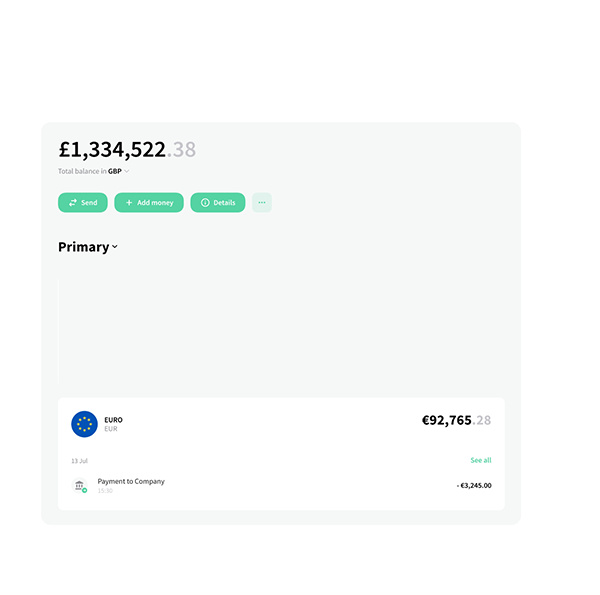
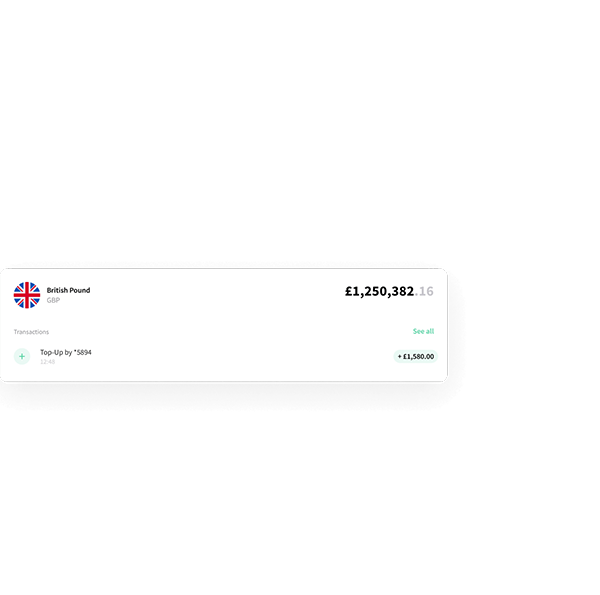
Integrated platforms eliminate that fragmentation. Under a single product and a single user profile, a customer can hold a personal or corporate IBAN (accessible via SEPA, SWIFT, and faster payments), manage crypto wallets for BTC, ETH, and stablecoins, exchange between fiat and crypto within the same app, and pass through a single unified KYC process rather than two separate ones.
Freelancer-focused neobank
Accept crypto payments from international clients, convert to EUR or GBP at market rate, withdraw via IBAN. One app, one KYC, no second account.
Corporate SaaS treasury
Pay IBAN suppliers in EUR while managing stablecoin earnings on-chain. Reduces FX round-trips and simplifies month-end reconciliation.
Wealth management app
Single dashboard showing crypto holdings alongside bank balances. Portfolio reporting across both asset classes without exporting to spreadsheets.
Exchange-linked neobank
Instant fiat funding from IBAN to exchange account; instant withdrawal back to IBAN after a trade. No third-party bank transfer delays.
Two market forces are pushing demand for this combined model. First, mainstream crypto adoption has moved the product from niche to expected: institutional participation, improving regulatory clarity under MiCA, and a new generation of users who see crypto and fiat as two sides of the same wallet. Second, platform consolidation - users want fewer apps and simpler workflows. A product that covers both wins on convenience before it wins on any feature comparison.
White-label crypto bank development path
Building a crypto banking product from scratch takes years and a specialist engineering team that most fintechs cannot staff or afford. White-label development offers an alternative: a pre-built, fully functional software platform that a business purchases, rebrands, and deploys as its own product. The underlying infrastructure is proven; the cost and risk of building it have already been absorbed by the platform provider.
The strategic case is straightforward. Custom development converts what should be operational cost into capital investment - and delays revenue by 18 to 36 months while the team builds core infrastructure instead of acquiring customers. A white-label solution flips that equation: the capital cost is low, revenue starts earlier, and the team can focus on marketing, brand, and customer relationships from day one.
| Path | Time to market | Upfront cost | Best for |
|---|---|---|---|
| Build from scratch | 18-36 months | $5M-30M+ | Tier-1 exchanges or banks with unique requirements and deep engineering capacity |
| White-label platform | 2-4 months | Low six figures | Fintechs, neobanks, EMIs, PSPs that want a branded product fast |
| Bespoke on a framework | 6-12 months | $1M-5M | Mid-market players needing significant customization beyond a standard white-label |
A typical white-label deployment follows seven stages: platform planning and architecture definition, branding and UI/UX customization, blockchain and wallet integration, security and compliance setup, testing and QA, deployment, and post-launch support. The stages are sequential but not slow - a well-structured platform compresses the total timeline to 8-16 weeks for an MVP.
Customization depth matters. Look for control over visual branding (logo, colours, typography), functional configuration (which assets are supported, fee schedules, transaction limits), and the ability to add custom modules via API without waiting for the platform roadmap. The best white-label relationships are ongoing partnerships, not one-time software purchases.
Compliance overlay: MiCA, CASP, and the Travel Rule
The regulatory environment for crypto banking shifted materially in 2024-2026 as the EU's Markets in Crypto-Assets Regulation (MiCA) came into full effect. MiCA creates a single licensing regime across all EU member states for crypto-asset service providers (CASPs), replacing the patchwork of national VASP registrations that preceded it. For anyone building a crypto banking product aimed at European customers, MiCA is the central compliance reference.
Outside the EU, the picture varies. The UK FCA operates a crypto registration regime (separate from MiCA). The US requires money transmitter licences at state level plus FinCEN MSB registration. Singapore's MAS licenses Digital Payment Token service providers under the Payment Services Act. A white-label platform's compliance tools must be configurable to the target jurisdictions, not hardcoded to a single regime.
Architecture and key management
Crypto bank architecture differs from standard fintech architecture in one decisive way: private key management. In traditional banking, the worst case of a software bug is a wrong number in a ledger - recoverable. In crypto, a compromised or lost private key means irreversible loss of the assets it controls. Architecture decisions around key management are therefore security decisions, not just engineering ones.
Cold storage (offline HSM)
Private keys for the bulk of assets (typically 90-95%) held in hardware security modules offline or in air-gapped vaults. Signatures performed offline; transactions broadcast separately. Slowest path but most secure.
Hot wallets (cloud KMS)
Keys for the operational float (5-10% of assets, enough for real-time withdrawals) managed in cloud KMS (AWS KMS, GCP Cloud KMS) with strict IAM policies, multi-sig thresholds, and velocity limits.
Multi-party computation (MPC)
Key shares distributed across parties or devices; no single point holds a full key. Transaction signing requires a threshold of shares to cooperate. Leading custodians (Fireblocks, Copper) use MPC as the default model.
Multi-signature schemes
M-of-N signing required to authorise a transaction. Useful for governance (requiring two approvers for large withdrawals) and for custodian independence.
Beyond key management, the architecture must handle the asynchronous nature of on-chain settlement. Unlike a SEPA credit transfer that settles deterministically, a Bitcoin transaction enters a mempool and may take minutes to confirm (or hours if fees are too low). The platform needs a mempool monitor, fee estimation logic, and a reorg-handling layer that waits for sufficient confirmations before marking a deposit as settled.
Scalability under market stress is a specific concern. Crypto markets spike violently - trading volumes on a single exchange can increase 10x in hours. The transaction processing layer must autoscale independently of the wallet layer, and rate limits must be configurable per customer tier rather than global. See the key management pillar for a full HSM vs cloud KMS decision framework.
Where Crassula fits
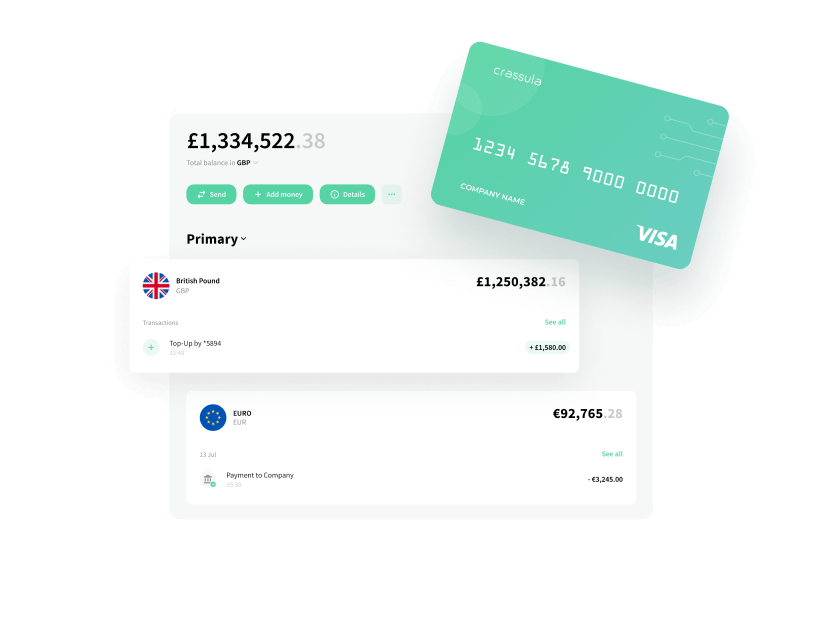
Crassula is a white-label fintech platform with over 150 companies already using it. The crypto banking product integrates fiat IBANs (SEPA, SWIFT, and faster payment networks) with cryptocurrency wallets and exchange functionality inside a single branded application - personal and corporate accounts, multi-chain wallets, fiat-to-crypto conversion, and unified KYC, all delivered under your brand.
The platform handles the infrastructure complexity - ledger, payments routing, wallet management, compliance tooling, admin dashboard, web and mobile front-ends - so the operator can focus on customer acquisition and product differentiation. Configuration covers the asset list, fee schedules, transaction limits, and branding without waiting for custom development cycles.
| What you need | What Crassula provides |
|---|---|
| Fiat bank accounts for your customers | IBAN issuance via regulated banking partners; SEPA, SWIFT, FPS access |
| Crypto wallets and custody | Multi-chain wallet infrastructure integrated with leading custodians |
| Fiat/crypto exchange in-app | Integrated exchange with configurable spreads and supported asset pairs |
| KYC/AML compliance | Integrated KYC workflows, transaction monitoring, Travel Rule support |
| Admin and operations | Full back-office dashboard with reporting, fee management, customer ops |
| White-label branding | Full brand customization: logo, colours, UI, mobile app store presence |
See the full crypto banking solution for the product in one place. Time to MVP is typically 8-16 weeks from contract to live product. The operator needs to bring a regulatory licence (CASP/VASP, EMI, or a partner arrangement) and a go-to-market plan. Crassula handles the software and the integrations. Post-launch, the platform evolves continuously - new features, regulatory updates, and new chain support ship without the operator managing infrastructure upgrades.
FAQ
Crypto Banking as a Service (CBaaS) is financial infrastructure - IBANs, payment rails, wallets, custody, on/off-ramps, AML/KYC, and exchange - delivered as a managed service to digital asset businesses or to fintechs that want to offer crypto banking under their own brand. CBaaS providers bridge the gap between the regulated banking system and the crypto ecosystem, so crypto businesses get the banking access and operational reliability they need without building it themselves.
A full crypto banking stack includes: multi-currency wallets (BTC, ETH, stablecoins, altcoins), a custody layer (cold storage and hot wallets with proper key management), fiat on/off-ramps, an integrated exchange or brokerage, AML/KYC and Travel Rule compliance tools, on-chain and off-chain transaction processing, an API integration layer for connecting to core banking and payment gateways, and an admin dashboard for operations and reporting. Security (HSM or cloud KMS, multi-factor authentication, audit trails) and scalability (autoscaling under market spikes) are architecture requirements, not optional modules.
Yes, and in 2026 this is increasingly what end users expect. Integrated platforms let customers hold a personal or corporate IBAN alongside crypto wallets in a single app with a single KYC process. They can receive fiat payments via SEPA or SWIFT, hold BTC or ETH, and convert between them in-app. The alternative - integrating a BaaS provider for the IBAN side and a separate crypto stack - works but adds operational cost, delays, and a fragmented user experience. Platforms like Crassula deliver both sides from a single integration.
In the EU, you need a CASP authorisation under MiCA from the competent authority in your home member state. MiCA covers custody, exchange, order execution, portfolio management, and crypto transfers on behalf of clients. A CASP authorisation passports across all EU member states. Outside the EU: the UK requires FCA crypto registration; the US requires money transmitter licences at state level plus FinCEN MSB registration; Singapore requires a Digital Payment Token service provider licence from MAS. If you also issue IBANs or process fiat payments, you need an EMI or PI licence as well - or a BaaS partner who holds one.
White-labelling a crypto bank means licensing a pre-built platform from a provider, branding it as your own product, and deploying it to your customers. The process covers: selecting a platform with the feature set you need (wallets, IBAN integration, exchange, compliance tools), configuring branding and UI, setting fee schedules and supported assets, connecting your regulatory entity or BaaS partner, completing security and compliance setup, testing, and launching. A well-prepared deployment takes 8-16 weeks to a live MVP. The platform provider handles ongoing infrastructure - software updates, new chain support, regulatory changes - while you handle customer acquisition and product decisions.
Crassula's typical MVP timeline is 8-16 weeks from contract signing to a live, branded product. The operator needs to bring a CASP/VASP licence (or an EMI/PI licence for the fiat side) and a go-to-market plan. Crassula handles the platform configuration, branding, integrations, and compliance tooling. Post-launch, ongoing platform updates, new chain support, and regulatory adaptations are managed by Crassula without requiring the operator to run infrastructure upgrades.