
Multipass is a financial services provider offering global business accounts, multi-currency payments, and cross-border transaction solutions.
Read case study
Czech Republic · Payment institution (platební instituce)
The CNB's own clearing system, CERTIS, now admits payment institutions as direct participants, so a Czech PI can settle koruna payments without a bank in the middle. Before that pays off, the transfer logic, the pricing and the sender data have to work every day. That part we run, whichever route your koruna takes.

Multipass is a financial services provider offering global business accounts, multi-currency payments, and cross-border transaction solutions.
Read case study

Paysend & Crassula - a banking solution for international companies
Read case study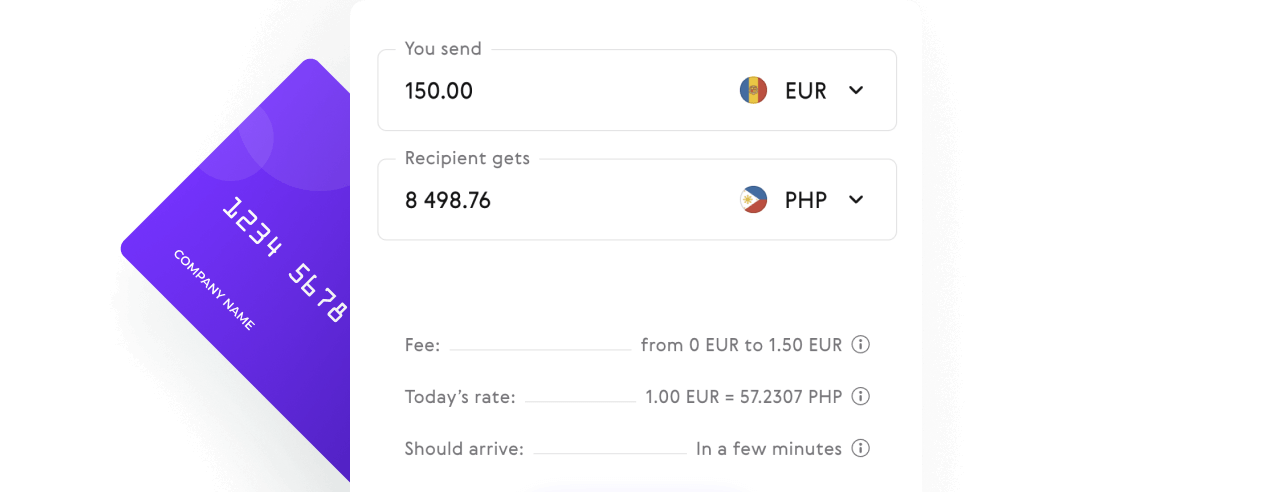

LuxPay is at the forefront of providing advanced financial services, designed to meet the needs of modern businesses and consumers alike.
Read case study

Wickie offers secure and scalable fiat and cryptocurrency payment solutions, providing users with digital wallets and seamless financial services across multiple platforms.
Read case study
Senders pay in CZK, choose a recipient in another country and confirm only after seeing the exchange rate, the fee and the amount the recipient will get.
Czech importers and staffing agencies send many payments at once from a file or the API. A second user signs off the batch before anything leaves.
Spreads and fees live in price lists per currency pair and client group, so CZK to EUR for business clients can carry another margin than CZK to UAH for individuals.


Accounts used only to carry out transfers. The balance is presented as money waiting for payout, not as a wallet to spend from.
Each transfer keeps a status history, so when a receiving bank rejects a payment your team can see where it stopped and send the money back to the right customer.
Each requirement, what the platform gives you for it and who owns it after launch.
A precise list of the payment services the platform carries out, so the services in your application and your capital tier line up.
You, with your lawyersBack office access for the Prague team to approve senders, corridors and payout batches, with a log of each decision.
YouPer-transfer ledger entries that show which funds are still in transit after each cut-off, exported for your reconciliation.
Your finance teamSender identity and address taken at onboarding and attached to every outgoing payment, with incoming data kept per transfer.
SharedClient limits per corridor and client type, and transfer exports for the screening and monitoring tools you connect.
Your AML officerName and IBAN data handed to the verification of payee service you use, with the answer shown to the sender before confirmation.
You, with your rails providerService description, data locations, subcontractors and exit terms for your outsourcing file and register.
You, with our input
Rails your customers can use
Rules that change what you have to build, in the order they apply.
Version 15 of the CERTIS rules took effect. It lists payment and e-money institutions among the firms that can be direct participants.
Czech payment institutions that offer euro credit transfers must be able to receive instant euro payments.
Sending instant euro payments and a payee name check on euro transfers become mandatory for them as well.
The EU Anti-Money Laundering Regulation applies, replacing parts of the Czech due diligence rules with one EU text.
PSD3 and the Payment Services Regulation are expected to apply. Expect the CNB to check existing authorisations against the new rules.
The CNB charges CZK 50,000 to receive a payment institution application and must decide within three months of the start of proceedings. We bring a running transfer platform and write the technical sections of the file around it.
A configured environment to show the regulator, not slides.
Payment flows, IT systems and security, ICT risk and DORA, outsourcing and continuity sections for your CNB file, ready for a Czech translation.
Banking, safeguarding and KYC providers from our network, matched to your licence.
Crassula provides technology and documentation support. We do not provide legal or regulatory advice and cannot guarantee the outcome of an application.

Imagine a team paying invoices for Czech e-commerce sellers who buy stock from suppliers in Poland, Germany and Asia. Sellers top up in koruna, the platform prices each payout at the corridor margin, and euro leaves over SEPA Instant while other currencies go over SWIFT through a connected provider.
The team starts with a bank collection account for koruna and models what direct CERTIS participation would change: no intraday credit, an account for payments only and separate safeguarding. They agree to revisit it once daily volumes make the operational work worthwhile.
Further reading: the Czech EMI and PI guide and how payment institution licences work.