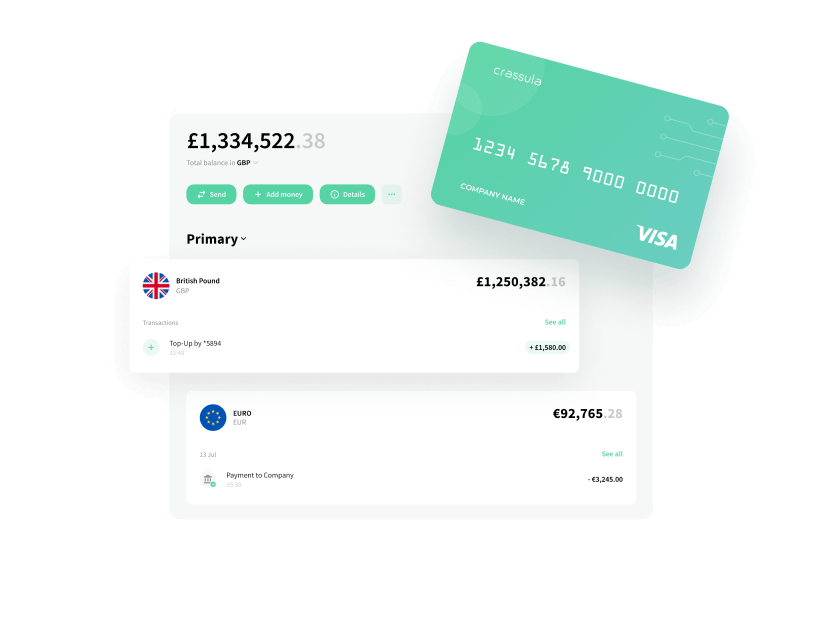

White-Label Debit Cards in 2026: The Complete Guide
A 2026 playbook for launching a branded debit card program: BIN sponsors, networks, processors, virtual-first issuance, spend controls, interchange economics, PSD3 and PCI DSS, and how to ship in weeks instead of months.
What is a white-label debit card in 2026?
A white-label debit card is a branded payment card issued on top of a licensed sponsor bank, a card network (Visa or Mastercard) and a processor, using your own UX, logo and card art. You design the product, your users see your brand, and a regulated partner carries the license, the compliance and the settlement risk. The card funds spend directly from a user account on your platform, rather than from a pre-loaded wallet.
In 2026, white-label is no longer a novelty. Chime, N26, Revolut, Ramp, Brex, GoHenry and most modern payroll and gig platforms run on some flavour of this stack. The difference versus building your own card program from scratch is measured in years: an independent issuer license plus direct network membership typically takes 18 to 36 months, while a well-scoped white-label launch routinely ships in 6 to 12 weeks.
Your brand, your UX
Card art, app, onboarding and spend controls carry your brand. The sponsor bank stays invisible to the cardholder.
Licensed partner
A BIN sponsor (Evolve, Stride, Celtic, Solaris, ClearBank) holds the network principal membership and the regulator relationship.
Virtual-first
Provision to Apple Pay and Google Pay seconds after KYC, then ship a physical card only when the user asks for one.
Let's discuss your project and see how we can launch your digital banking product together
Request demoThe four players in every card program
Behind every white-label debit card there are four distinct roles. Knowing them tells you who owns your BIN, who moves the money, who authorises the transaction, and where each basis point of interchange lands.
BIN sponsor
Licensed bank or EMI that owns the Bank Identification Number, holds customer funds and takes regulatory accountability. Evolve, Stride, Celtic, Lead Bank, Patriot, Solaris, ClearBank, Griffin.
Network
Visa or Mastercard route the authorisation message, clear the transaction and set interchange rates. In the EU CB in France and domestic schemes still matter for in-store usage.
Processor
Marqeta, Galileo, Stripe Issuing, Highnote, Lithic in the US; Enfuce, Paynetics, Thredd (ex-GPS), Tribe in Europe. Handles authorisation, tokenisation, ledger entries, 3DS and push provisioning.
Program manager
Your platform (or a BaaS orchestrator like Crassula) that owns the user, KYC, funding accounts, spend controls, disputes and the admin back office.
In a real transaction the flow is linear: user taps a terminal, merchant acquirer sends an ISO 8583 message to the network, the network routes to the processor, the processor checks your spend controls and available balance, your program manager approves or declines, and the answer travels back in under 300 milliseconds. Interchange is settled T+1 or T+2, and a revenue share drops into your ledger.
Virtual-first issuance and push provisioning
The single biggest product shift of the last three years is virtual-first. In 2019, a card program meant a plastic rectangle mailed two weeks after sign-up. In 2026, 70 to 90% of new cards are issued virtually, land in Apple Pay or Google Pay within seconds of KYC approval, and generate the first transaction the same day.
Just-in-time funding
The card authorises at zero balance, your platform funds the exact amount during authorisation, the network approves. Cash stays in your treasury until the moment of spend.
Push provisioning
One tap inside your app pushes the card into Apple Pay or Google Pay, with the device token replacing the PAN. No waiting for a plastic card to arrive.
Physical on demand
Plastic and metal cards ship only when a user requests one. Metal is a retention play for premium tiers: Revolut Ultra, Chase Sapphire, Brex Premium.
Economically, virtual-first cuts card production cost per active user by roughly 80% and shortens time-to-first-transaction from days to seconds. Operationally, it moves fraud from mag-stripe skimming to enumeration and account takeover, which is why 3DS 2.2, device binding and behavioural biometrics are now baseline rather than premium features.
Spend controls: the real product differentiator
The card is a commodity. The controls wrapped around it are not. Modern programs compete on how precisely they can steer or restrict spend at authorisation time, which is what makes a gig-worker card useful for fuel, a corporate card useful for ads, and a youth card safe for parents.
| Control | What it does | Typical use case |
|---|---|---|
| MCC restrictions | Allow or block merchant category codes (fuel, groceries, gambling, travel). | Gig-worker cards only usable at fuel and EV charging; youth cards blocked on gambling and crypto. |
| Per-merchant limits | Cap spend at a named merchant or merchant group per day or month. | Expense cards with a hard cap at AWS, Google Ads or LinkedIn. |
| Velocity rules | Maximum count and value of transactions in a rolling window. | Fraud containment, kids' cards, single-use virtual cards for online shops. |
| Geography | Country, region or specific merchant-location rules at authorisation. | Block cross-border on payroll cards; allow EU-only on youth cards. |
| Time windows | Allow spending only during certain hours or weekdays. | Employee lunch cards active 11:00 to 15:00; taxi allowances active on business trips. |
| Single-use tokens | Virtual card number burned after the first successful authorisation. | Subscription trials, vendor onboarding, one-off supplier payments. |
Ramp and Brex built nine-figure ARR businesses out of exactly these controls. The message for any team launching a program: design your rule engine before you design your card art.
Use cases that actually print money
Not every audience is a good fit for a debit card program. The six below are the ones where white-label economics and product fit line up in 2026.
Neobanks
Chime, Current, N26 and Bunq anchor the account in a debit card. Card interchange pays for customer acquisition and the free account itself.
Payroll and earned wage access
Gusto, DailyPay and Branch issue payroll cards that fund the moment payroll runs. Same-day access becomes the retention hook for the employer contract.
Gig-worker cards
Uber Pro, DoorDash Red and Instacart pay drivers same-day with MCC-locked cards that reward fuel and discount maintenance.
Corporate expense
Ramp, Brex and Pleo issue thousands of cards per customer with per-vendor caps and auto-reconciliation into Xero, NetSuite and QuickBooks.
Youth banking
GoHenry, Greenlight and Revolut 18 give parents granular controls and teenagers their first real card, with chores and allowance built in.
Crypto debit cards
Crypto.com, Binance Card and Gnosis Pay auto-convert from a crypto balance at authorisation, with spend in local fiat and cashback in the token of choice.
Interchange economics: the 2026 numbers
Interchange is the single most misunderstood number in fintech. It decides whether a program is a profit centre or a loss leader. The rules are very different on each side of the Atlantic, and they change the product you can afford to build.
| Region | Regulated rate | Who it applies to | What it means |
|---|---|---|---|
| United States (Durbin) | ~0.05% + $0.22 on regulated issuers | Banks with over $10B in assets | Durbin-regulated cards earn very little. |
| United States (exempt) | ~1.5% to 2.0% | Banks under $10B in assets (Evolve, Stride, Celtic, Lead, Patriot, Piermont) | The "Durbin-exempt" BIN sponsor model is why US neobanks pick small community banks. |
| EU and EEA | 0.2% debit, 0.3% credit | All consumer cards (Interchange Fee Regulation) | Lower ceiling forces interchange to be one revenue stream among several, not the only one. |
| UK | 0.2% debit, 0.3% credit | Retained post-Brexit | Same caps as the EU; cross-border within the UK is regulated too. |
| Commercial cards | 1.5% to 2.5% globally | Corporate, expense and B2B cards | Why Ramp, Brex, Pleo and Spendesk focus on business, not consumer. |
A US consumer neobank on an exempt BIN can run the entire product on interchange alone. A European consumer fintech cannot, and needs FX, subscription, lending or treasury to make the maths work. A commercial program anywhere in the world is self-funding from day one at meaningful volume.
Regulation: PSD2, PSD3 and PCI DSS in 2026
Launching a card program means inheriting a regulatory stack. Most of it is carried by your BIN sponsor and processor, but program managers still own real obligations.
- PSD2 and SCA. In the EEA and UK, strong customer authentication (3DS 2.2, biometric or possession factor) applies to remote card transactions above €30, with exemptions for low value, trusted beneficiary and transaction risk analysis. Any program manager running an e-commerce-heavy flow needs to tune exemption logic carefully or watch conversion drop.
- PSD3 and PSR. Political agreement was reached in late 2024 and early 2025, with implementation landing around 2026 and 2027. For card issuers the practical changes are tighter fraud liability, expanded SCA exemptions, clearer rules for agent and distributor models, and a refreshed EMI licensing regime.
- PCI DSS 4.0. Fully enforced since March 2025. Program managers typically qualify as SAQ D merchants or service providers and lean on their processor's Level 1 attestation, but your app and back-office still need scoped controls, tokenisation and regular penetration tests.
- US sponsor-bank oversight. After the consent orders against Cross River, Evolve, Blue Ridge and Choice in 2023 to 2025, sponsor banks now push reconciliation, BSA/AML and third-party oversight contractually onto program managers. Expect real audits, not paperwork.
- Network rules. Visa and Mastercard publish their own operating regulations on branding, chargebacks, dispute timelines and token lifecycle. Non-compliance fines are real and come from your BIN sponsor.
The practical takeaway: pick a white-label partner that has already internalised these rules, rather than hiring a compliance team to learn them from scratch.
Launch: white-label vs direct
There are three honest paths to shipping a branded debit card. Pick the one that matches your ambition, your cap table and your timeline.
| Path | Time to launch | Capital needed | Best fit |
|---|---|---|---|
| Direct: own license and network membership | 18 to 36 months | €15M+ plus network collateral | Well-capitalised challengers aiming at primary-account status, proprietary credit and international expansion. |
| BIN sponsor + processor, assembled in-house | 4 to 9 months | €0.5M to €3M | Teams with fintech engineering depth that want control over the stack and are happy to integrate Marqeta or Galileo themselves. |
| White-label platform (e.g. Crassula) | 6 to 12 weeks to MVP | Low six figures | Product teams that want a branded card without rebuilding ledger, KYC, card program and admin back office from scratch. |
Crassula sits on the orchestration layer: ready-made ledger, KYC, card-program management, spend-control engine, virtual and physical issuance, Apple Pay and Google Pay push provisioning, disputes, statements and admin back office. Plug into your own licensed entity or one of our BIN partners and ship a branded program in weeks.
Where white-label debit cards go next
Three trends are visible in the 2026 roadmap of every serious processor and program manager.
- Stablecoin-settled cards. Visa and Mastercard both support USDC settlement for issuers and Gnosis Pay runs cards directly on-chain. Crypto programs that used to rely on custodial conversion are moving to real-time on-chain authorisation.
- AI-driven controls. Authorisation decisions, fraud scoring and dispute triage are majority-model-driven at the leaders. For expense cards this means fewer false declines; for consumer cards this means better loss ratios at lower cost.
- Programmable money. Spend controls are moving from static MCC lists to dynamic rules tied to budgets, policies and approvals. The card stops being a plastic rectangle and becomes a policy enforcement point.
The programs that win the next cycle are the ones that treat the card as a surface for software, not as the product itself. The plastic is a channel; the controls, the data and the flows are the business.
FAQ
A white-label debit card is a branded payment card that you ship under your own logo using a licensed sponsor bank, a card network (Visa or Mastercard) and a processor underneath. You design the UX and keep the customer relationship; the sponsor bank holds the license and the regulator relationship. It is how Chime, N26, Ramp, Brex and GoHenry shipped cards without becoming banks themselves.
A debit card spends from a live account balance at the sponsor bank, usually with just-in-time funding from your platform. A prepaid card spends from a pre-loaded wallet and cannot go below zero. In 2026 most modern programs are technically debit with stored balances, because interchange is better and the user experience is closer to a real bank account.
In the US the leaders are Evolve Bank & Trust, Stride Bank, Celtic Bank, Lead Bank, Patriot Bank and Piermont Bank, most of them Durbin-exempt. In the EU and UK the main names are Solaris, Swan, ClearBank, Griffin, Paynetics, Modulr and Intergiro. The right sponsor depends on the network, the geography and whether you need a debit, credit or commercial program.
Marqeta is the pick for programmable controls, virtual cards and expense management (Ramp, Brex, Uber). Galileo powers many neobanks (Chime, Dave). Stripe Issuing, Highnote and Lithic are strong on developer experience and virtual-first. In Europe Enfuce, Paynetics, Thredd (ex-GPS) and Tribe are the usual choices. A white-label platform like Crassula lets you treat the processor as swappable.
Realistic ranges in 2026: low six figures for a white-label MVP on top of a platform like Crassula, €0.5M to €3M to assemble BIN sponsor and processor in-house, and €15M plus multi-year timelines for your own license and direct network membership. Ongoing unit economics are driven by interchange, FX spread, card-production cost and fraud losses.
Six to twelve weeks for a well-scoped white-label MVP with virtual cards, Apple Pay and Google Pay push provisioning, spend controls and admin back office. Physical plastic cards add one to three weeks for production and shipping. Complex programs (corporate expense with accounting integrations, crypto settlement, cross-border) typically stretch to three to six months.
Usually no. Your BIN sponsor (a licensed bank or EMI) carries the card-issuing license and the network principal membership. You still need your own AML program, onboarding policies and often an agent or distributor registration with the regulator. If you plan to hold customer deposits directly or lend from your own balance sheet, you will eventually need your own license.
Crassula is the program-manager and orchestration layer. We provide the ledger, KYC orchestration, spend-control engine, virtual and physical card issuance, Apple Pay and Google Pay push provisioning, disputes, statements and the admin back office. You plug into your own licensed entity or one of our BIN partners and ship a branded debit card in weeks, with the freedom to swap processor or sponsor later without a rewrite.